
The Importance of Value-Based Education: The Need for Reviving Ancient Wisdom in Modern Times

The Crisis of Education Without Values
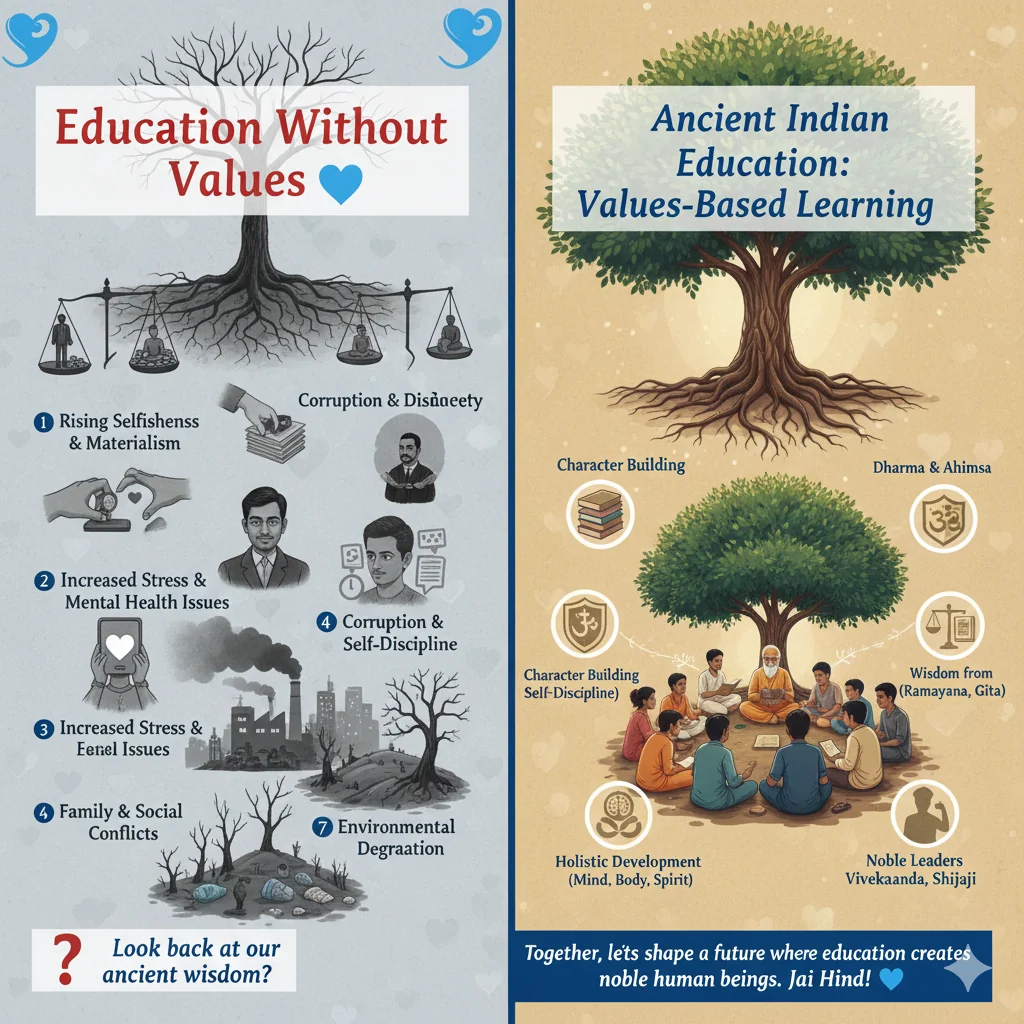
Education is often considered the foundation of a progressive and developed society. However, in modern times, a crucial aspect of education has been overlooked—values. Today, academic excellence is emphasized, but moral integrity, social responsibility, and personal ethics are often neglected. The result is evident in the increasing cases of corruption, greed, selfishness, and an overall decline in ethical conduct in society.
We see brilliant engineers but ones who manipulate systems for personal gain, skilled doctors who exploit patients for financial benefit, politicians who serve themselves rather than the people, and businessmen who prioritize profits over ethics. The lack of value-based education has led to the degradation of social structures, broken families, and an overall decline in human well-being. Without a strong moral compass, even the most educated individuals can become a threat rather than a boon to society.
The increasing stress, depression, and lack of purpose among youth further highlight this crisis. Suicide rates among students, unethical business practices, and intolerance in society are rising at an alarming rate. The reason is simple: our education system produces individuals who are intellectually competent but emotionally and spiritually hollow.
The question then arises—how can we integrate values into education? The answer lies in our own cultural roots. Ancient India had a highly sophisticated system of imparting value-based education, which not only produced intellectuals but also responsible and ethical individuals. It is time we look back at our ancient wisdom and implement those teachings in today’s education system.
The Adverse Effects of a Lack of Value-Based Education
When education lacks a strong value-based foundation, it leads to various social, ethical, and moral problems. Some of the major adverse effects include:
1. Rising Selfishness and Materialism
In the absence of moral guidance, individuals often develop a self-centered approach to life. Society begins to measure success solely by wealth, status, and power rather than by character, integrity, and service. This materialistic mindset creates divisions, increases greed, and leads to unethical practices in business, governance, and personal life.
2. Corruption and Dishonesty
A lack of ethical education results in corruption at every level of society. Leaders, officials, and even common people engage in dishonest practices for personal gain. This erosion of integrity leads to a society where justice is compromised, and merit takes a backseat to nepotism and bribery.
3. Increased Stress and Mental Health Issues
Without values like contentment, gratitude, and self-discipline, individuals struggle with stress, anxiety, and depression. They chase external validation and materialistic goals without finding inner fulfillment. The increasing rates of mental health issues today can be traced back to a lack of emotional and spiritual grounding in education.
4. Family and Social Conflicts
When children grow up without moral teachings, they often fail to respect elders, understand the importance of relationships, or resolve conflicts peacefully. This results in broken families, increased divorces, and weakening of societal structures that once provided support and guidance.
5. Environmental Degradation
A lack of values like respect for nature and sustainable living leads to reckless exploitation of natural resources. Ancient Indian philosophy emphasized harmony with nature, but today’s education system does not instill this responsibility in young minds. The result is pollution, deforestation, and climate change.
Ancient Indian Education: The Legacy of Value-Based Learning
Ancient India’s education system was not just about acquiring knowledge; it was about character building, self-discipline, and spiritual growth. The concept of Gurukul was central to this. In a Gurukul, students lived with their guru (teacher) in a close-knit environment, learning not just subjects like mathematics, astronomy, and medicine, but also fundamental human values like honesty, humility, respect, discipline, and selflessness.
Teachers in ancient India played a parental role. They were not just instructors but also life guides who instilled virtues such as Dharma (righteousness), Ahimsa (non-violence), Satya (truthfulness), and Seva (service). Students were taught the importance of duty, devotion, and self-restraint. Education was not limited to acquiring knowledge but focused on the holistic development of an individual—physically, mentally, and spiritually.
Great epics like Ramayana and Mahabharata were not just stories; they were profound teachings on life, ethics, and governance. For example, Lord Rama’s life teaches us about duty, sacrifice, and leadership, while the Bhagavad Gita imparts wisdom on righteousness, selfless action, and inner strength.
Chanakya, the great strategist and philosopher, emphasized the importance of moral education for rulers and administrators. His teachings ensured that kings ruled with justice, fairness, and responsibility.
This education system produced not only scholars but also noble leaders like Swami Vivekananda, Maharana Pratap, Chhatrapati Shivaji Maharaj, and other great personalities who shaped Indian civilization with their wisdom, courage, and morality.
What Should Value-Based Education Look Like Today?
While we cannot return to the exact Gurukul system, we must integrate its essence into modern education. Today’s value-based education should include:
1. Ethical and Moral Education
Students should be taught ethical decision-making from a young age. Subjects like Dharma, integrity, and self-discipline should be incorporated into the curriculum. Lessons from the Bhagavad Gita, Panchatantra stories, and historical figures should be included to impart real-life wisdom.
2. Practical Life Skills & Emotional Intelligence
Education should prepare students for life, not just for jobs. Lessons on stress management, handling failures, financial discipline, and emotional intelligence should be a part of the syllabus. The concept of Karma Yoga from the Bhagavad Gita—selfless action without attachment to results—should be introduced to students to help them handle failures and success gracefully.
3. Patriotism and Social Responsibility
In ancient times, students were taught that their primary duty was towards society and their nation. Today’s education should instill a sense of patriotism and duty towards the country. Youth should be encouraged to contribute to society through social service, environmental consciousness, and ethical leadership.
4. Spiritual and Philosophical Awareness
While science and technology are crucial, they should be complemented with spiritual wisdom. Meditation, yoga, and philosophical discussions should be a part of school education. The concept of the Atman (soul) and the law of karma should be taught to help students develop a deeper understanding of themselves and the world around them.
5. Respect for Indian Heritage and Culture
Our education should include appreciation for Indian arts, literature, and philosophy. Sanskrit, which is a treasure trove of wisdom, should be reintroduced. Great Indian thinkers like Swami Vivekananda, Aurobindo, and Rabindranath Tagore should be studied and their teachings integrated into school curricular
What Our NGO is Doing to Bridge This Gap
Recognizing the urgent need for value-based education, our NGO has taken the initiative to revive this lost tradition. We have developed structured educational modules that aim to bring value-based education to students across schools, especially in rural and underprivileged areas.
For Primary School Students (3rd to 6th Grade) – We use interactive storytelling methods inspired by the Panchatantra, Ramayana, and Mahabharata to teach values such as honesty, respect, and responsibility. Fun activities and role-plays help children internalize these lessons.
For Middle and High School Students (7th to 12th Grade) – We conduct sessions on practical life skills, leadership lessons from great Indian personalities, and the Bhagavad Gita’s wisdom. Students engage in discussions on topics like self-discipline, inner strength, and decision-making.
Spiritual and Cultural Exposure – At the end of our three-month value-based education program, we organize educational trips to places of spiritual and historical significance. These trips include storytelling sessions, dramas, and discussions about the rich cultural heritage of India.
Workshops for Teachers and Parents – We believe value-based education is not just for students but should involve teachers and parents as well. We conduct workshops to help them understand the importance of values in upbringing and provide them with tools to nurture ethical and responsible individuals.
Conclusion: A Call to Action
Education without values is like a tree without roots. It may grow, but it will not bear the right fruits. As we move towards technological advancements and material success, we must not forget our ancient wisdom that has stood the test of time.
It is the duty of educators, parents, and organizations to ensure that value-based education is revived and given the importance it deserves. By integrating ethical teachings, spiritual wisdom, and practical life skills into education, we can build a society where individuals are not only intelligent but also compassionate, responsible, and morally strong.
Our NGO is committed to this mission. We invite you to join hands with us in this noble endeavor. Together, let’s shape a future where education is not just about creating professionals but also about creating noble human beings.
Let us return to our roots, revive our lost wisdom, and build a society that truly reflects the greatness of Indian culture and values. Jai Hind!